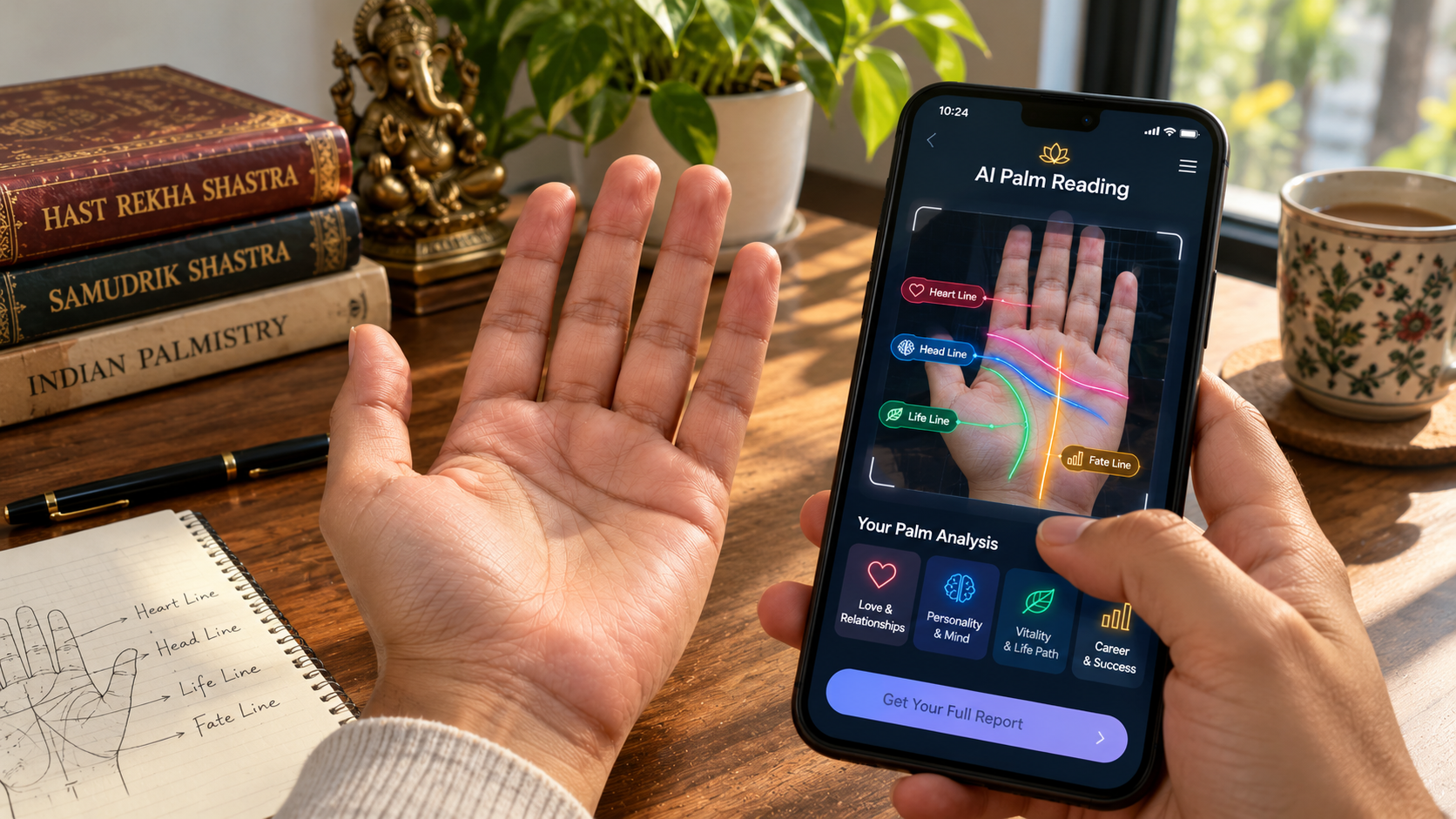
Palmistry has been part of Indian life for centuries, usually under the name Hast Rekha Shastra, a branch of Samudrik Shastra, the traditional study of body features. Now AI palm reading puts that practice on your phone. You photograph your palm, and an app returns an interpretation within seconds. This guide explains how the technology works, what the main lines are said to mean, how accurate the results really are, and how to choose an online tool without risking your money or privacy.
What Is AI Palm Reading?
AI palm reading is software that detects lines and shapes in a photo of your palm and matches them with interpretations from traditional palmistry. Detecting lines is a technical task that AI can do well. Predicting your future from them is not, because no reliable scientific evidence supports palmistry as a predictive method. Treat it as entertainment and reflection, not guidance for major decisions.
How Does AI Palm Reading Work?
Most online tools follow a similar pipeline, although each developer builds it differently.
- Image capture: You take or upload a photo. Light, focus, and hand position strongly affect the result.
- Pre-processing: The software adjusts contrast and separates the palm from the background.
- Line detection: A computer vision model finds creases, typically the heart, head, life, and fate lines.
- Feature extraction: The tool measures length, depth, curvature, breaks, and where each line starts and ends.
- Interpretation: Features are matched with palmistry meanings, either through fixed rules or a generative AI model that writes the report.
- Report: You receive a summary, usually grouped under love, mind, vitality, and career.
Steps one to four are image analysis. Step five depends entirely on palmistry traditions, which differ between schools, so two apps can read the same palm differently.
Palm Lines Meaning: Heart, Head, Life, and Fate Lines
Traditional palmistry focuses on four principal lines. Here are common interpretations, with the Hindi names used in Hast Rekha Shastra. Meanings vary between practitioners.
- Heart line (Hriday Rekha): Runs across the upper palm, below the fingers. Commonly associated with emotions and relationships.
- Head line (Mastishk Rekha): Runs across the middle of the palm. Commonly associated with thinking style and decision-making.
- Life line (Jeevan Rekha): Curves around the base of the thumb. Commonly associated with vitality and major life changes.
- Fate line (Bhagya Rekha): Runs vertically up the centre of the palm. Commonly associated with career path and outside influences.
A popular myth says the life line’s length shows how long you will live. Palmists generally say it reflects energy and life experience instead. A University of Adelaide study of 60 donated cadavers, published in Anthropological Review, tested the longevity claim and did not support it. The fate line is absent in many people, and that is not considered negative.
Indian tradition also reads the mounts, called parvat, named after Guru (Jupiter), Shani (Saturn), Surya (Sun), Budh (Mercury), Shukra (Venus), and Chandra (Moon), along with finger length and palm shape. Many palmists read the dominant hand for present traits and the other for inherited ones, but this is a convention, not a rule.
Is AI Palm Reading Accurate?
Accuracy means two different things.
Technical accuracy is whether the app detects your lines correctly. With a sharp, well-lit photo this can be reasonable, but shadows, blur, rings, and a tilted hand reduce it.
Predictive accuracy is whether the reading says something true about your personality or future. No reliable scientific evidence supports this. AI can detect a line, but it cannot make that line meaningful.
The Barnum effect adds another layer. In 1949, psychologist Bertram Forer gave his students an identical personality description, told them it was individual to each of them, and asked them to rate its accuracy. Most rated it highly. A line like “you are caring but sometimes doubt yourself” feels personal, yet it fits almost anyone. Many reports, human or AI, use this style.
For this reason, do not use any palm reading to decide matters of marriage, medical care, investments, or jobs. For health concerns, consult a qualified doctor.
AI Palm Reading vs Traditional Palmist
Speed: AI palm reading takes seconds. A traditional palmist usually needs a scheduled sitting.
Consistency: A clear image usually gives similar line detection each time. A palmist’s reading varies by practitioner and school.
Personal context: AI is limited to your image and any form you fill. A palmist can ask questions and examine the hand directly.
Cost: AI tools often offer a free basic tier with paid reports. A palmist’s fees vary.
Privacy: An AI tool may store your image digitally. A palmist keeps no digital record unless your hand is photographed.
Scientific basis for prediction: None for either.
Benefits and Limitations
Benefits: AI palm reading is convenient, lets you explore palmistry privately, and can prompt useful reflection about your strengths and goals.
Limitations: It cannot predict outcomes, interpretations differ between apps, results depend on photo quality, and generative tools can produce confident-sounding text that follows no consistent palmistry method. Your hand image may also be collected as data.
Common Myths About Palm Reading Apps
- A longer line means a better life. Length is only one feature, and its meaning differs between schools.
- A broken line signals misfortune. Palmists often describe breaks as change or transition, and creases vary naturally from person to person.
- A paid report is more accurate. Price says nothing about method. Free and paid reports may draw on the same interpretations.
- The AI knows your future. It detects lines and matches them with written text. It has no insight into your life.
Who Should Try AI Palm Reading?
It suits readers curious about Hast Rekha Shastra, or anyone wanting a low-pressure introduction before consulting a palmist. It does not suit anyone seeking medical, legal, financial, or relationship decisions, and it should never replace professional advice.
How to Choose a Trustworthy Online Palm Reading Tool
Check these points before you upload anything.
- Transparency: Look for a tool that states whether readings come from fixed rules or generated text, and labels results as guidance or entertainment. Avoid any that promise exact predictions.
- Privacy: Look for clear consent, a stated storage period, and no sharing without permission. Avoid tools with no privacy policy.
- Pricing: Look for the price in rupees shown upfront, clear free and paid features, and renewal terms. Avoid hidden auto-renewal or repeated upsells.
- Tone: Look for a balanced, non-alarming style. Avoid warnings of doom or dosha followed by paid remedies.
- Consistency: Look for similar output for the same image. Be wary of drastically different readings.
Privacy in India. A palm image can be personal data, especially when linked to your name, phone number, or account. India’s Digital Personal Data Protection Act, 2023 governs digital personal data, and the DPDP Rules, 2025 were notified in November 2025, with obligations phasing in over up to 18 months. A credible service should explain how it seeks consent and handles your data.
Free versus paid. Before paying, confirm what the free reading includes, what costs extra, and how renewals work. Check the price in rupees and read the cancellation terms before approving any UPI or card payment.
How to Get a Better Scan
- Use bright, even natural light and avoid harsh shadows.
- Keep your palm open and flat, with fingers slightly apart.
- Hold the camera directly above your palm, not at an angle.
- Remove rings or bangles that cover the lines.
- Retake the photo if the lines look faint or blurred.
Scanning both hands separately shows how consistent a tool is. Daylight near a window usually works better than indoor bulbs. Avoid flash.
Frequently Asked Questions About AI Palm Reading
Is AI palm reading accurate?
It can detect palm lines accurately in a clear photo, but there is no reliable scientific evidence that those lines predict your future. Treat it as entertainment.
Is AI palm reading free?
Many tools offer a free basic reading, while detailed reports may be paid.
Is it safe to upload my palm photo?
That depends on the service. Read the privacy policy, check how your image is stored, and avoid tools that do not explain their data practices.
Can AI palm reading predict marriage or career?
No. It offers interpretations based on palmistry traditions, which are not scientifically proven predictors.
Which hand should I scan?
Traditions differ, but many palmists read the dominant hand for present traits and the other for inherited ones. Scanning both is reasonable.
Final Thoughts
AI palm reading blends an old tradition with modern image recognition. It can be a convenient way to explore palm line meanings and reflect on yourself, provided you keep expectations realistic. The technology reads the lines on your hand, but it cannot confirm what they mean. Choose tools that are transparent, respect your privacy, and avoid fear-based claims. Used sensibly, it is a harmless way to explore tradition.